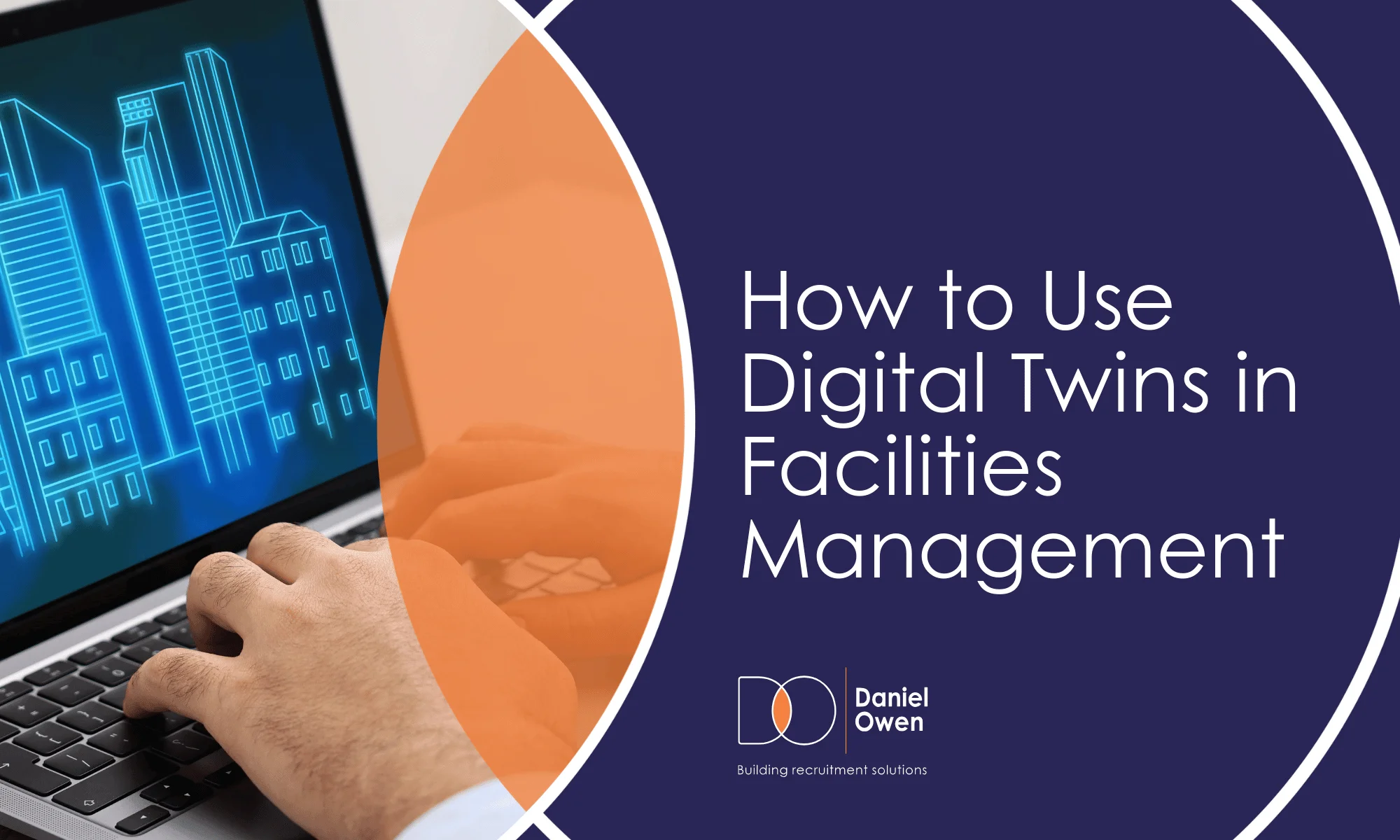
How to Use Digital Twins in Facilities Management
24 Jun, 20265 MinutesThe UK built environment accounts for roughly 25% of the country’s total greenhouse ga...
The UK built environment accounts for roughly 25% of the country’s total greenhouse gas emissions.
As the clock ticks down to the 2030 Net Zero targets, the pressure on facilities management (FM) providers, public sector estates, and commercial landlords is reaching a tipping point.
Decarbonising an estate is no longer just a corporate social responsibility initiative; it is an urgent matter.
To achieve these ambitious targets, changing lightbulbs and optimising cleaning schedules is no longer enough. The built environment requires a data-driven revolution, and at its heart is digital twin technology.
In this guide, we explore how digital twins are reshaping the FM landscape, how they drive Net Zero delivery, and what hiring managers must do to build the tech-enabled FM teams of the future.
What is a Digital Twin?
There is often confusion between Building Information Modelling (BIM) and digital twins.
While BIM provides a static, highly detailed 3D blueprint of a building’s design and construction, a digital twin goes a step further.
A digital twin is a live, virtual replica of a physical building.
It connects directly to Building Management Systems (BMS), IoT sensors, and utility meters to ingest real-time data on temperature, occupancy, energy consumption, and asset health.
Rather than looking at a static model, an Estates Manager orTechnical Services Manager can look at a digital twin to see exactly how a building is performing in real time.
How Digital Twins Help with Net Zero
Digital twins help FM teams to move from reactive maintenance to proactive, predictive energy management.
Here is how they support 2030 Net Zero targets:
- Live Energy Optimisation:
Digital twins highlight energy wastage that traditional BMS platforms might miss. For example, they can identify when HVAC systems are conditioning empty office spaces or when plant equipment is running inefficiently. - Virtual Retrofit Testing:
Before investing in costly decarbonisation upgrades, such as replacing gas boilers with commercial heat pumps, FM teams can simulate the upgrade within the digital twin. This allows them to validate carbon savings, predict ROI, and identify potential integration issues before a single spanner is lifted. - Lifecycle Asset Performance:
Digital twins track the wear and tear on hard-service assets. By servicing a chiller or AHU exactly when the data dictates, rather than on a rigid calendar schedule, FM providers extend asset life, reduce the carbon footprint of manufacturing replacement parts, and ensure equipment runs at peak efficiency.
Who’s driving adoption? Real-world examples of digital twin success in Facilities Management
The adoption of digital twins is increasing across various sectors, driven by FM contractors, commercial property management businesses and public sector estates looking to deliver robust ESG (Environmental, Social and Governance) strategies.
Commercial offices are using digital twins to support hybrid work. Managing agents and FM teams can track real-time occupancy alongside heating and cooling data, automatically adjusting HVAC systems to cut energy use when areas are underused, while keeping staff comfortable.
The healthcare sector benefits from monitoring critical assets, predicting maintenance needs before failures impact patient care, and optimising the high energy needs of surgical wards and labs.
Educational sectors are using digital twins to gain a holistic view of their emissions, helping them target the worst-performing buildings to gain retrofit funding and clearly evidence Net-Zero progress.
The cost of falling behind
For FM contractors, commercial landlords, and public estates, the risks of ignoring digital transformation are severe. Buildings that cannot evidence clear, data-backed Net Zero progress run the risk of becoming "stranded assets"—properties that are unlettable, unsellable, and non-compliant with tightening energy regulations such as MEES (Minimum Energy Efficiency Standards).
Furthermore, relying on outdated manual energy reporting leaves FM providers vulnerable. In today’s competitive market, contractors bidding for public sector tenders or corporate FM contracts must prove their ESG credentials. Those unable to offer tech-enabled, data-led carbon reduction strategies will simply lose out to more digitally mature competitors.
How to implement digital twins in FM
Transitioning to a digital twin strategy can feel daunting.
For FM providers and building owners looking to adopt this technology, a phased, strategic approach is essential:
1. Conduct a Data and BMS Audit
A digital twin is only as good as the data feeding it. Before investing in software, assess your current BMS and infrastructure. Are your IoT sensors capturing granular data? Are your smart meters communicating correctly? Poor data quality is the single most common pitfall in digital twin projects.
2. Secure Operational FM Buy-In
Digital twins fail when they are treated purely as top-down IT projects. Your Technical Services Managers, Energy Managers, and site-based Facilities Managers must be involved from day one. If the operational teams do not understand the platform or see how it makes their jobs easier, they will not use it.
3. Start with a Pilot Project
Do not attempt to digitise a national portfolio overnight. Select a single, complex building to pilot the technology. Use this pilot to test the integration, prove carbon savings, and refine your operational processes before scaling across the wider estate.
4. Shift from Project to Culture
Implementing a digital twin is not a "fire and forget" software installation; it represents a fundamental change in how a building is operated. It requires ongoing management, continuous data refinement, and a cultural commitment from the FM team to action the insights the twin provides.
Recruiting for Net-Zero - Facilities Management Recruitment
Tech alone can’t deliver net-zero; it requires the right people.
We’re seeing a change in skills required across all levels of building operations.
Facilities Managers, Energy Managers, and Sustainability Managers need stronger capabilities in data analytics, BMS/IoT integration, and ESG reporting.
Even on the tools, maintenance is changing, with mobile engineers and technical staff needing to be comfortable working alongside predictive AI algorithms, smart building platforms, and digital work-order systems.
How Daniel Owen Can Help
This skills shift will present a significant change.
The facilities management market is already facing documented talent shortages; finding candidates that blend traditional building services knowledge with modern digital literacy is essential.
We connect forward-thinking employers with the future-ready professionals required to turn ambitious sustainability targets into operational reality.
Get in touch with our specialist FM team >>
Or submit a vacancy and get relevant, experienced candidates sent directly to your inbox >>
Currently hiring and not sure what to offer? Don’t let that be the reason you miss out on that top-tier applicant.
Click here to get a free custom salary report sent to you within one business day.
Related Posts
What Does a Net Zero Building Look Like?
09 Sept, 2026
How to Get an Ehanced DBS: Step by Step Guide
26 Aug, 2026