A Guide to Data Centre Construction
22 Oct, 20265 MinutesTL;DR: A data centre construction project normally moves through five stages: planning,...

TL;DR: A data centre construction project normally moves through five stages: planning, site selection, design and tender, construction, and commissioning and handover. Power, cooling, connectivity and resilience guide decisions throughout. Project Directors and Project Managers coordinate the people, programme, budget and risks, while specialist engineers and trades deliver and test the facility.
Building a data centre involves much more than putting up a secure building and installing servers. The facility must have reliable power, cooling, connectivity and security. These systems must also work together during normal use and if equipment fails.
For this reason, data centre construction needs careful planning from the start. It also needs strong project leadership and input from a wide range of technical specialists.
Why data centre construction needs specialist planning
A data centre is designed around the IT equipment it will support. This shapes its power, cooling, layout, fire protection and security requirements.
Reliability is also essential. Backup systems, known as redundancy, help the data centre continue operating if a key system fails. As these systems are closely linked, even a small design change can affect multiple parts of a project.
The exact level of redundancy depends on the facility's purpose, the client’s requirements, and the agreed design.
This is why the Project Director and Project Manager should be involved from the early planning stage.
Stage 1: Planning and site selection
Before design work goes too far, the project team must understand what the data centre needs to achieve.
This includes its planned IT capacity, security needs and resilience requirements.
The team should also consider future growth, as expanding the facility later may require more space, power and cooling.
What to look for when choosing a data centre location
Not every site suits a data centre. Site reviews will normally consider:
- The amount of electrical power available
- Access to fibre and network connections
- Ground conditions and flood risk
- Planning and environmental constraints
- Road access and construction logistics
- Space for generators, cooling equipment and other plant
- Options for future expansion
- Access to experienced workers and specialist contractors
Power and connectivity can be major factors in whether a project can move forward. Explore these early, rather than after the site has been chosen.
The role of project leadership
The Data Centre Project Director provides senior oversight. They help set the delivery strategy, establish governance and keep the project aligned with the client’s goals.
The Project Manager turns this strategy into a working plan. During the planning stage, they may coordinate surveys, design information, cost planning, risk reviews and stakeholder meetings.
They do not need to design every technical system. However, they need enough understanding to ask the right questions and bring in suitable experts.
Stage 2: Design and tender
Once the project requirements and preferred site are clear, the design team can develop the building and its technical systems.
The team may include architects, civil and structural engineers, mechanical and electrical engineers, fire engineers, security consultants, network designers and sustainability specialists.
Together, they develop plans for:
- The structure and building envelope
- Electrical distribution and backup power
- Cooling and ventilation
- Fibre and network connections
- Fire detection and protection
- Physical security and access control
- Building management and monitoring systems
- Safe maintenance access
- Future expansion
Data centres built for AI and other high-performance computing uses may need to support greater power and cooling requirements. Identify these needs early because they can affect the entire building design.
Managing design changes
Design changes must be carefully managed, as even a small change can affect costs, safety, timescales and several work packages.
Once the design is agreed, contractors can be appointed and long-lead equipment, such as generators, switchgear and cooling systems, can be ordered.
Stage 3: Construction and technical installation
Construction begins with site prep, groundworks, drainage and foundations. Then the teams complete the structural frame, roof, external walls, and maintain plant areas.
As the building takes shape, more specialist trades join the project. These may include:
- Electricians and electrical engineers
- Mechanical and cooling specialists
- Pipefitters
- Controls and building management system engineers
- Cable and network installers
- Fire-stopping teams
- Security-system installers
- Quality assurance and quality control teams
- Health and safety professionals
The order of these activities matters. Different systems may need to use the same ceiling, wall or floor spaces. Poor coordination can lead to clashes, delays and rework.
Project Managers, Construction Managers and Site Managers help here. They monitor progress, resolve technical queries and coordinate inspections. They also ensure completed systems are protected and prepared for testing.
Stage 4: Commissioning and handover
Finishing the physical installation does not mean the data centre is ready to operate.
Commissioning checks that equipment has been installed correctly and performs as intended. Systems are first tested on their own and then as part of the wider facility.
Testing may cover:
- Electrical distribution and backup power
- Cooling equipment and controls
- Fire detection and protection
- Security and access systems
- Building management systems
- Network and communication systems
- Simulated equipment or power failures
The team may test how the facility responds when switching between power supplies.
Commissioning should be planned early, with clear tests, responsibilities and acceptance requirements. Any faults must be corrected and retested.
Step 5: Handovers
Handover then provides the operations team with the information needed to run the facility. This can include operating manuals, asset records, test results, training and details of any outstanding work.
Data Centre Construction Recruitment
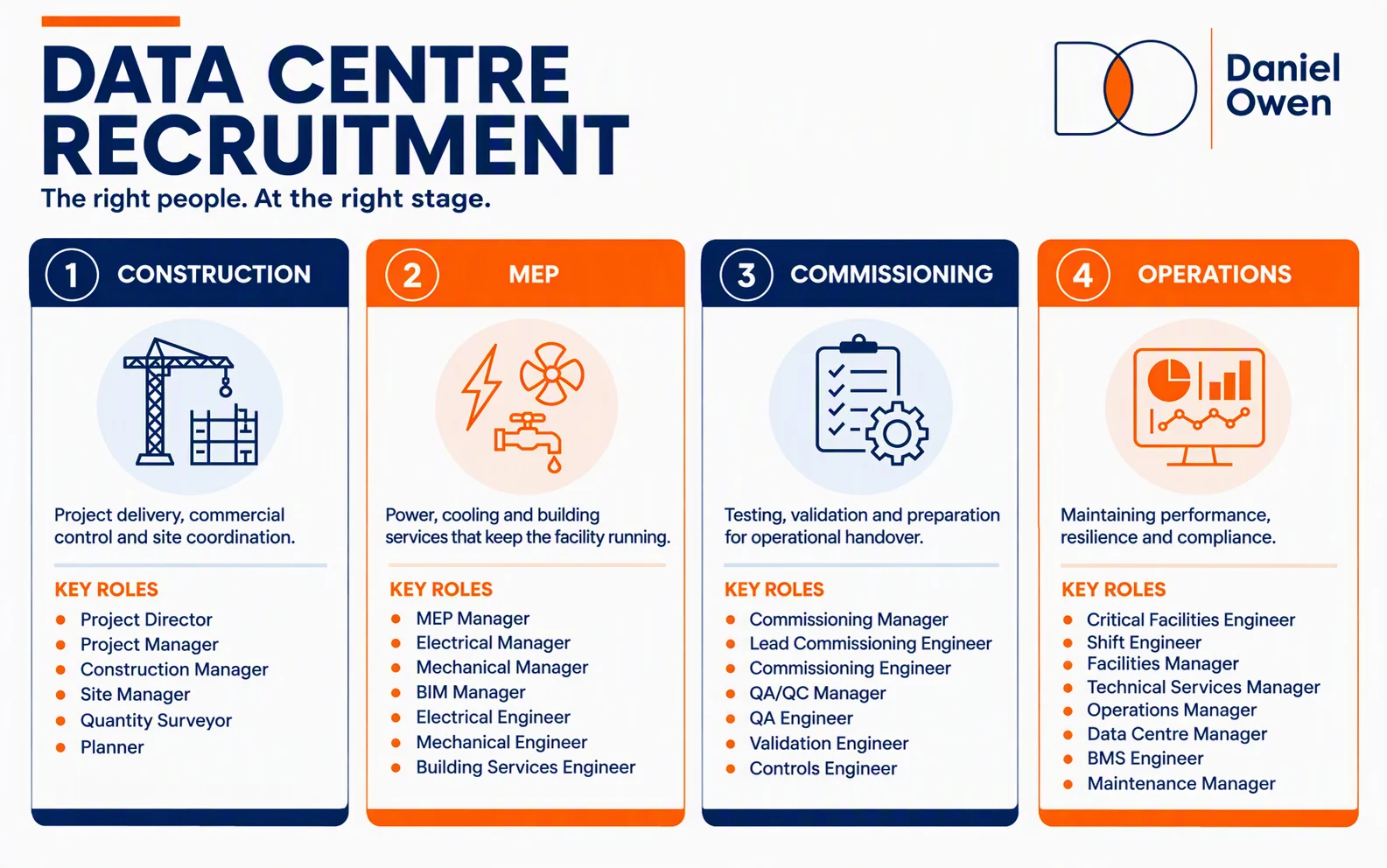
The skills needed on a data centre project change as the build moves from planning to operation. Recruitment follows the project programme, with the right people joining at each stage.
Construction
Early data centre construction jobs focus on planning, leadership, commercial control and site delivery.
Project Directors and Project Managers oversee the wider programme, while Construction Managers, Site Managers, Quantity Surveyors and Planners help control activity on site.
Skilled trades are also needed as groundworks, concrete, steelwork, roofing and the building envelope progress.
Previous data centre experience may be important for some roles. However, experience from major construction, industrial or infrastructure projects may also transfer well.
Mechanical and electrical
Power and cooling are central to a data centre, making mechanical and electrical skills especially important.
Electrical Managers, Mechanical Managers, MEP Managers and Building Services Engineers help coordinate these systems.
The wider workforce can include electricians, pipefitters, plumbers, HVAC engineers, controls engineers and fire-protection specialists.
Mechanical and electrical systems often share the same spaces, so technical knowledge, quality control and experience of complex installations are valuable.
Commissioning
Commissioning checks that the data centre’s systems have been installed correctly and perform as intended.
Commissioning Managers and Commissioning Engineers work alongside QA/QC teams, Controls Engineers and technical specialists to plan tests, record results and resolve faults.
These roles should not be left until the end of construction. Earlier involvement improves test planning and helps prepare the facility for handover.
Operations
Once the data centre is live, the focus moves to reliable day-to-day operation. Critical Facilities Engineers, Shift Engineers, Facilities Managers and BMS Engineers monitor equipment, plan maintenance and respond to technical issues.
Experience in building services, engineering, energy infrastructure or facilities management may provide a route into these roles.
However, duties, working patterns, and responsibilities can vary across construction, commissioning, and live data centre environments.
Understanding where a role sits in the project lifecycle is often more helpful than focusing on the job title alone.
Technical duties, working patterns, and levels of responsibility can vary between construction, commissioning, and a live data centre environment.
Looking for data centre recruitment support?
Explore our mission-critical infrastructure recruitment services or get in touch with our team.
FAQs
How long does it take to build a data centre?
There is no single construction period for every data centre. The programme depends on the site, size, design, planning process, power connection, equipment availability and testing requirements.
What are the main stages of data centre construction?
The five stages are planning, site selection, design and tender, construction, and commissioning and handover.
What does a data centre Project Manager do?
A data centre Project Manager coordinates the programme, people, risks, costs, information and work packages. The role also manages communication between the organisation receiving the facility, designers, contractors and technical specialists.
Which trades work on data centre projects?
Data centre projects can involve groundworkers, steel erectors, electricians, mechanical installers, pipefitters, cooling specialists, controls engineers, fire-protection teams and security-system installers.
What is data centre commissioning?
Commissioning checks that equipment and systems have been installed correctly and perform as intended. It includes testing systems separately and together, including their response to agreed fault or failure scenarios.
Why do data centres need backup power?
Data centres support IT equipment that may need to remain available during a power problem. Backup systems can help maintain power when the normal source is unavailable.
Related Posts

What is Mission-Critical Infrastructure?
23 Sept, 2026