
What is Mission-Critical Infrastructure?
23 Sept, 20265 MinutesMission-critical infrastructure refers to facilities and systems where disruption could have...

Mission-critical infrastructure refers to facilities and systems where disruption could have significant operational, economic or safety consequences.
Most people encounter these environments every day without realising it.
Data centres support the digital services we rely on; telecommunications infrastructure keeps people connected, energy networks power homes and businesses, and healthcare facilities depend on reliable systems to support patient care.
In September 2024, the UK Government designated data centres as Critical National Infrastructure, recognising their importance alongside sectors such as energy, water and emergency services.
While requirements vary, mission-critical facilities are built on resilience, continuity and risk management to reduce disruption and support essential services.
Which industries rely on mission-critical infrastructure?
Data Centres
Data centres are a core form of mission-critical infrastructure.
They provide the environment for servers, storage systems and networking equipment that support cloud computing, business operations, financial services, healthcare systems and everyday digital activity.
Key infrastructure often includes:
- Electrical distribution
- Backup power systems
- Cooling and environmental control
- Fire protection
- Building management systems
- Physical security
Delivering these facilities requires expertise across design, construction, commissioning and operations.
This is why data centre projects often involve construction managers, quantity surveyors, electrical engineers, commissioning specialists and facilities teams.
Telecommunications
Telecommunications infrastructure supports network connectivity, data transfer and communications services.
This can include exchanges, network operations centres, communications hubs and supporting power systems.
Because businesses depend on uninterrupted connectivity, these facilities are often designed for continuity and resilience.
Power and Energy
Mission-critical facilities rely on dependable power infrastructure.
This includes power generation, substations, electrical distribution systems, battery storage and standby power solutions.
As projects become more complex, employers often need people with experience in specialist electrical environments and compliance-led projects.
Healthcare and Life-Safety Facilities
Hospitals and healthcare environments rely on electrical, mechanical and communications systems to support critical services.
Work can take place within live environments where reliability, planning and clear communication are essential.
Other Critical Infrastructure Examples
Mission critical principles also apply to sectors such as:
- Water and utilities
- Transport
- Emergency services
- Defence
- Government facilities
- Financial infrastructure
Systems and regulations may differ, but the goal is similar: maintaining services that organisations and communities depend on.
The Mission Critical Lifecycle
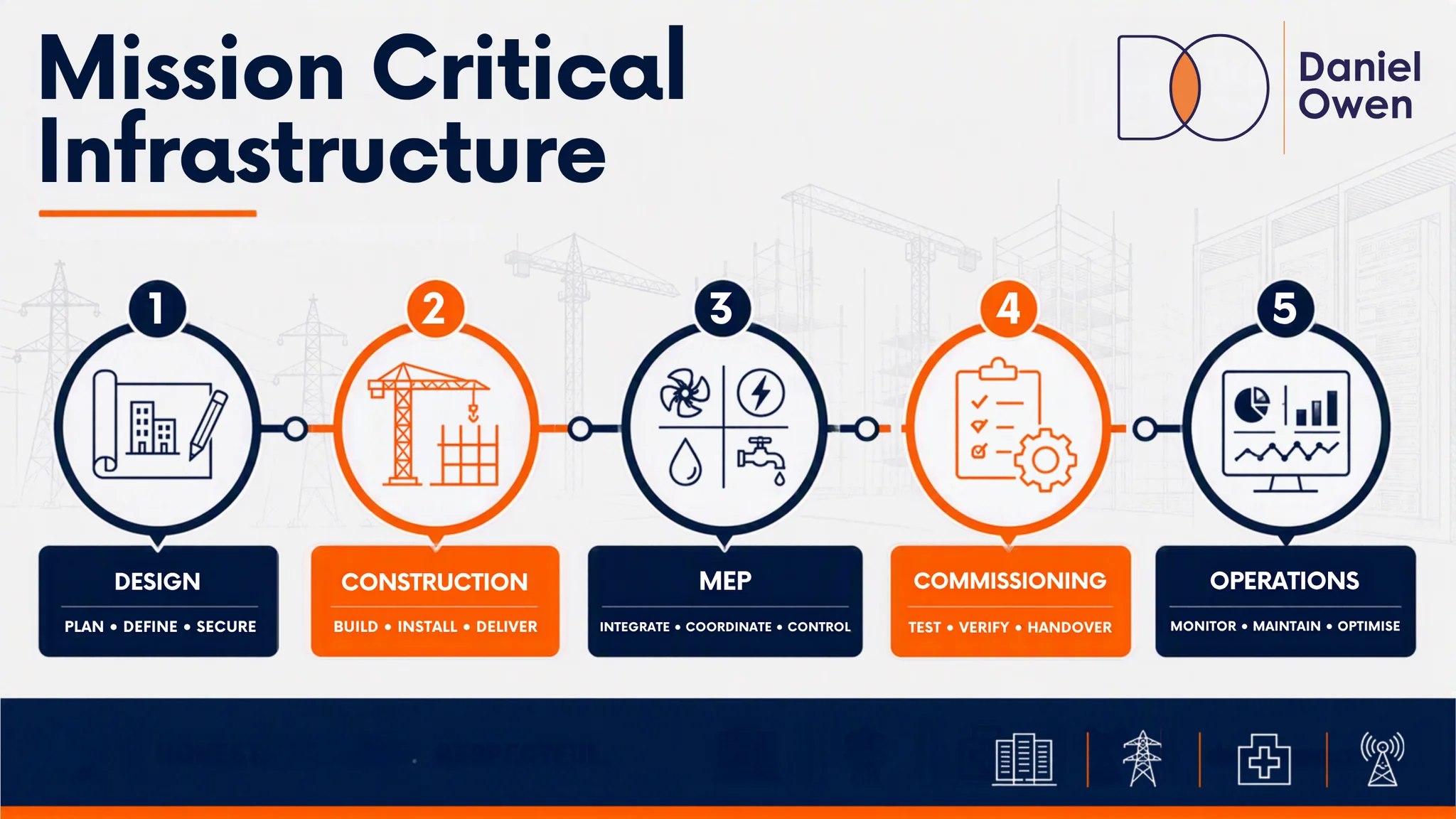
Design
Every project begins by defining operational requirements, risks and performance expectations.
Design teams consider factors such as capacity, resilience, maintainability, security and future expansion.
Construction
Construction brings together multiple technical disciplines, often including civil, mechanical and electrical works.
Successful delivery depends on quality control, coordination and effective project management.
Mechanical, Electrical and Plumbing (MEP)
MEP systems support the power, cooling, ventilation, water and environmental controls required within mission-critical facilities.
Delivery can involve MEP managers, electrical and mechanical engineers, building services engineers and BIM managers working together to coordinate complex installations.
Commissioning
Commissioning verifies that systems perform as intended before a facility becomes operational.
For mission-critical projects, this stage is particularly important because it provides confidence that systems have been installed and tested correctly.
Operations and Facilities Management
Once operational, facilities require ongoing maintenance, monitoring and asset management.
Facilities teams help ensure systems continue to perform effectively while managing operational risk and compliance requirements.
What jobs are available in mission-critical infrastructure?
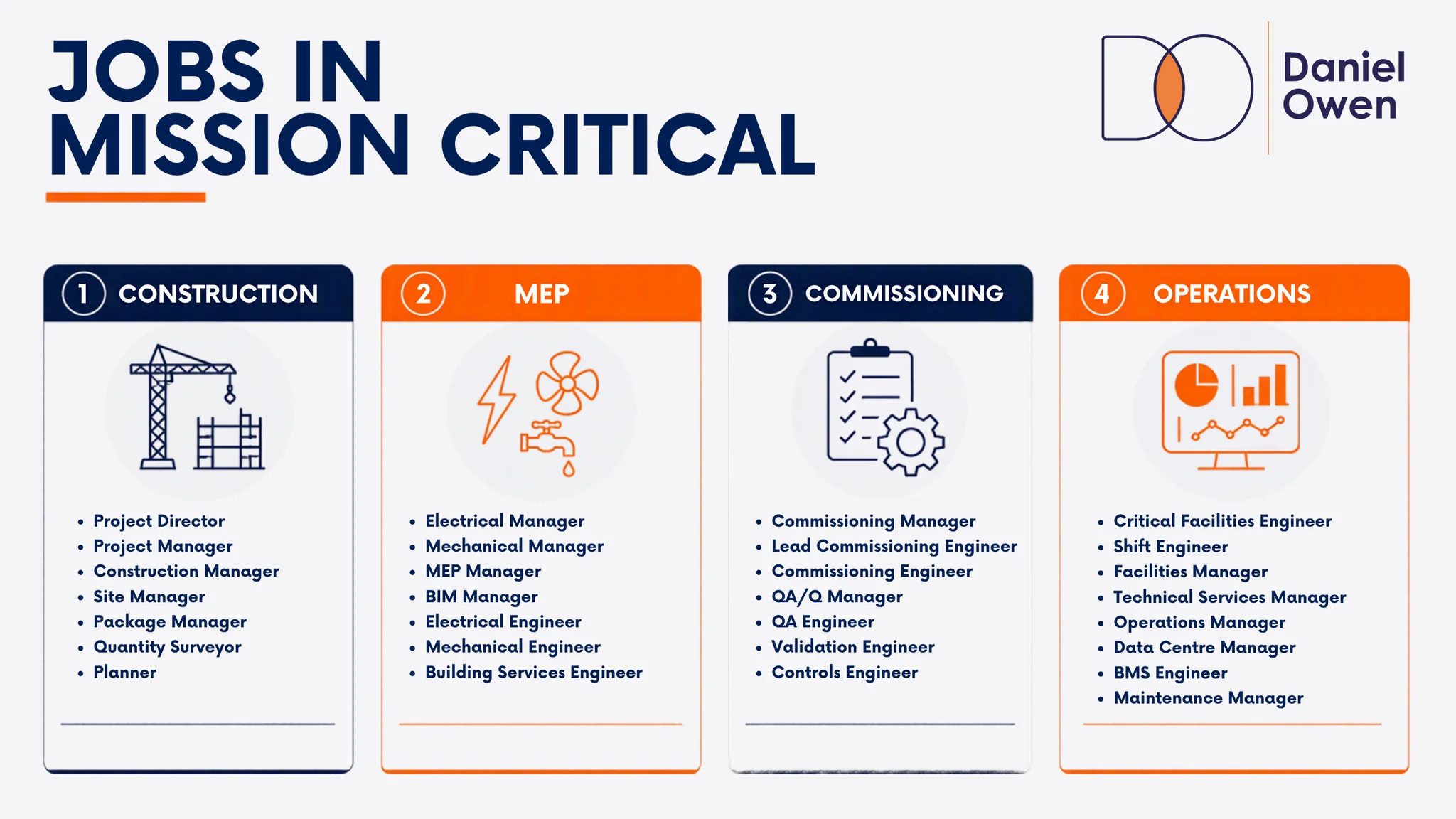
Mission-critical infrastructure brings together specialists across the full project lifecycle, from early construction through to commissioning and ongoing operations.
Area | Example roles | Typical focus |
Construction | Project Directors, Project Managers, Construction Managers, Site Managers, Package Managers, Quantity Surveyors and Planners | Project delivery, programme management, commercial control and site coordination |
MEP | MEP Managers, Electrical Managers, Mechanical Managers, BIM Managers and Building Services Engineers | Coordinating the mechanical, electrical and plumbing systems that support the facility |
Commissioning | Commissioning Managers, Commissioning Engineers, QA/QC Managers, Validation Engineers and Controls Engineers | Testing, quality assurance, validation and preparation for operational handover |
Operations | Critical Facilities Engineers, Shift Engineers, Facilities Managers, Technical Services Managers, Operations Managers, Data Centre Managers and BMS Engineers | Maintaining performance, resilience and compliance within live technical environments |
Whether you're exploring data centre jobs or advancing an established career, understanding where a role sits in the project lifecycle is often more useful than focusing solely on the job title.
Mission Critical Infrastructure Recruitment
Mission critical recruitment is not as simple as a job title match.
Employers may need staff with experience in:
- Live operational environments
- Data centre construction
- Commissioning projects
- Compliance-led sectors
- Electrical and mechanical systems
- Security-sensitive facilities
A clear brief helps define which skills are genuinely required and which are simply desirable.
Your recruitment partner should understand the role, assess candidates against the spec, and verify qualifications and compliance requirements before putting anyone forward.
They should also have experience working in complex operational environments where factors such as vetting requirements, mobilisation, and compliance can influence hiring decisions.
We've supported recruitment in complex operational environments before.
Click here to see how we delivered a security-sensitive recruitment solution >>
How to build the right mission-critical teams
From data centres and telecommunications facilities to power infrastructure and healthcare environments, these projects bring together specialist skills across construction, engineering, commissioning and facilities management.
Whether you're looking to strengthen a project team or explore your next opportunity, understanding the technical and operational requirements behind these environments is the first step towards making the right recruitment decision.
Looking to speak to a mission-critical recruitment specialist?
Related Posts
What Does a Net Zero Building Look Like?
09 Sept, 2026

How to Get an Ehanced DBS: Step by Step Guide
26 Aug, 2026