A Guide to Data Centre Construction
22 Oct, 2026


You're standing in front of a building labelled "net zero." It looks like... a...


You're standing in front of a building labelled "net zero." It looks like... a building. So, what exactly are you supposed to be looking at?
Net Zero is a performance claim, not an aesthetic one.
There's no single visual signature.
Once you know the indicators, they're easy enough to spot, and knowing them is fast becoming essential for anyone working in facilities management.
Start with the roof. Solar PV panels are the clearest sign. They don't prove a building is net zero, but they're common.
Next, look at the building's shape. Compact, simple designs reduce surface area and help limit heat loss.
Check the windows too. High-performance or triple glazing, deeper window reveals, and carefully controlled window sizes can all point to better energy efficiency.
At ground level, look for air-source heat pumps, which resemble air-conditioning units. Just as important is what's missing: newer net-zero buildings often lack gas flues, boiler vents, or other conventional heating infrastructure.
Finally, scan the wider site. Larger developments may also use small wind turbines or other renewable energy systems.
The most important features are the ones you can't see. Thick insulation, airtight construction, and carefully sealed joints all help reduce heat loss and improve energy efficiency.
New homes are being built to much higher airtightness standards than before. On site, you can spot this indirectly by looking for mechanical ventilation systems instead of trickle vents, checking the quality of window sealing, and noticing whether the building feels free from draughts.
These are also common features of Passive House and other low-energy buildings. Together, they show a fabric-first approach, improving the building itself before relying on renewable technology.
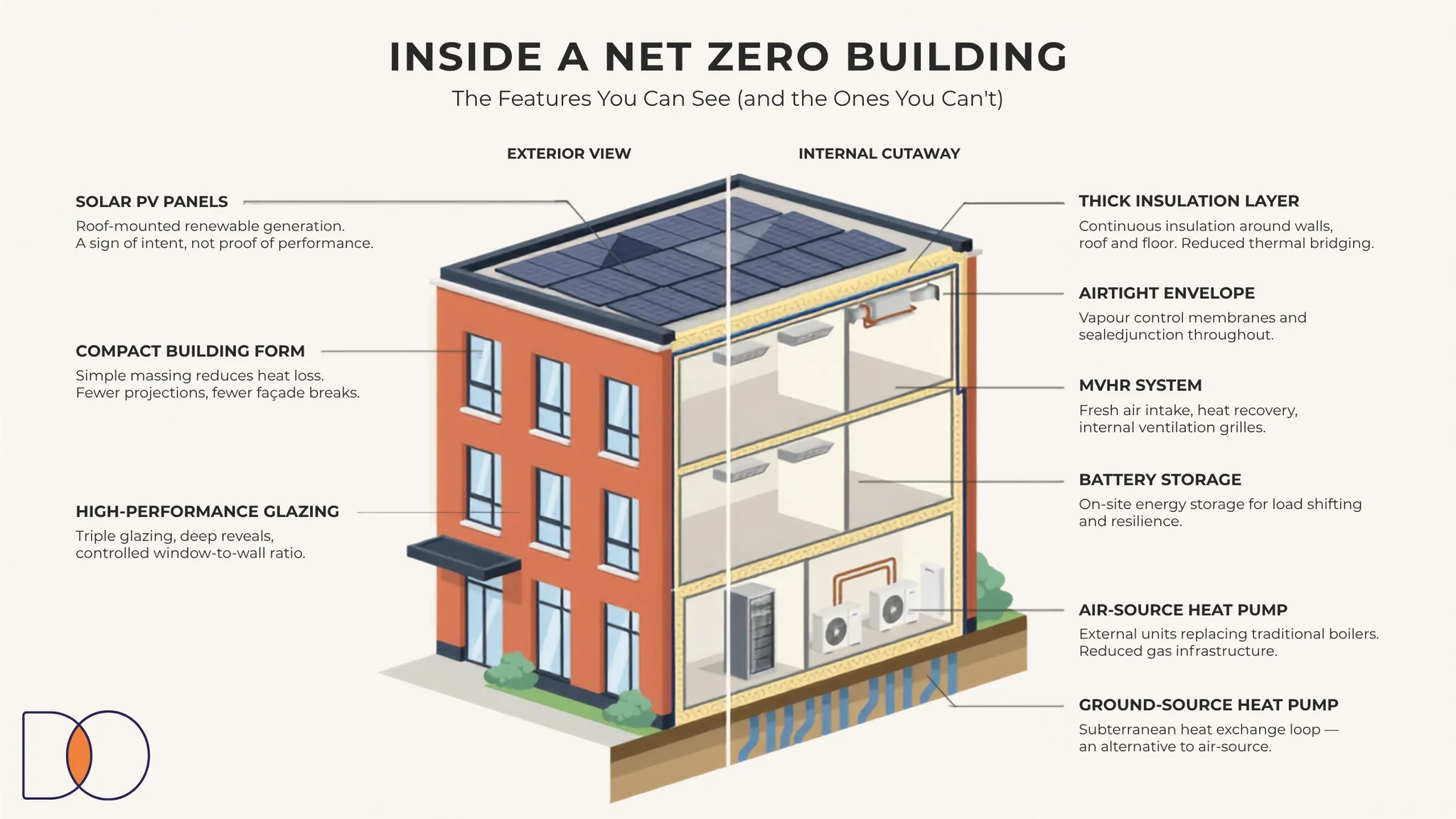
Solar PV panels may be the most visible feature, but the systems doing the hard work are usually hidden.
MVHR units are typically housed in plant rooms or utility cupboards, while battery storage is often installed in service areas. Ground-source heat pumps have no visible external equipment, so you'll need to check plant room records or commissioning documents to confirm they're installed.
For facilities managers, these systems require ongoing maintenance.
MVHR units need regular filter changes, and battery storage should be included in planned maintenance schedules, so it's worth checking what's covered before taking on a new building.
A typical 4kW rooftop solar PV system costs thousands, but it can pay for itself in around 8.4 years.
However, those savings depend on the building's systems being properly maintained.
Want to learn more about the role of a Facilities Manager? Click here >>
These are often used interchangeably, but they shouldn't be.
Net zero energy means annual consumption is balanced by renewable generation.
Net zero carbon means emissions from energy use during occupation net to zero.
Whole-life net zero carbon is the big one, covering embodied carbon from materials, construction, and eventual demolition too.
Not all net zero certifications measure the same thing. Some focus only on a building's operational emissions, while others also include the carbon from its materials, construction, and maintenance.
For Facilities Management teams reporting against ESG targets, that distinction matters. A building labelled net zero energy may still have significant embodied carbon.
As sustainability reporting requirements grow, understanding exactly what your building’s certification covers is the first step towards accurate reporting.
There is no single price tag for making a commercial building net-zero. Costs depend on its age, condition, size, existing systems and the depth of retrofit required. A planned, phased approach is often more cost-effective, combining energy optimisation and lighter interventions with planned refurbishment and replacement cycles.
For new buildings, integrating energy efficiency, low-carbon heating and whole-life carbon considerations at design stage can help avoid costly future interventions. For existing offices, improvements can be staged from controls and lighting to fabric upgrades, ventilation and low-carbon heating.
The quickest wins are optimising controls, heating and cooling, and reducing unnecessary energy use. Deeper carbon savings can follow through fabric improvements and heat decarbonisation.
Net-zero retrofit does not have to happen all at once. A clear long-term plan can align improvements with maintenance and refurbishment cycles, reducing disruption while steadily improving building performance.
Designing a net zero building is one challenge. Running it properly is another entirely.
Facilities managers now need to understand MVHR schedules, heat pump performance, solar export agreements, and embodied carbon reporting.
These skills don't transfer neatly from conventional FM roles, and the training pipeline hasn't caught up.
CITB and UKGBC both point to a real skills shortage in green construction and retrofit, with demand for sustainability-literate FM professionals and energy managers only growing.
Daniel Owen has spent nearly 40 years placing skilled professionals across the built environment, with specialist coverage in renewable energy, sustainable construction, and FM roles carrying an expanding green remit. We know what these roles actually require, not just what's written in the job title.
Spotting a net zero building starts with the obvious markers like solar panels, compact form, high-performance glazing, and heat pumps at ground level. But the real telling is inside the fabric and in the certification behind it. Net zero energy, operational carbon, and whole-life carbon are different claims requiring different evidence.
And none of it means much without the right people running it.
Demand for verified net zero specialists is outpacing supply, fast. Knowing what these buildings look like, structurally and on paper, is where getting it right actually starts.
Get in touch with your local team today >>